

Vuulr: Licensing Content Is Now Faster and Simpler Than Ever
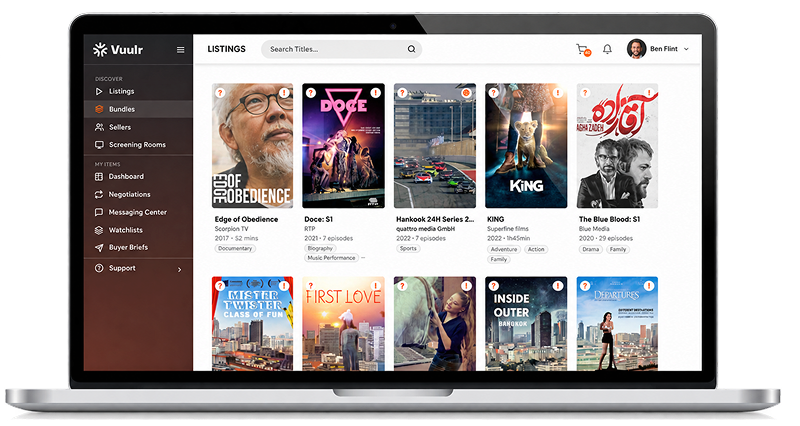
Vuulr is the leading global online content marketplace for premium Film & TV content rights. Recently transformed into “The Rights Transaction Platform for All Content”, it connects buyers, distributors and creators of Film and TV worldwide, online, 24/7.
In this interview, Ben Flint, Chief Commercial Officer, Vuulr, talks about how the platform has evolved in recent years, reaching around 15.000 customers from across the globe, and setting records like closing deals in just 12 days. At MIPCOM, the company is launching a new white label product, VuulrOS, which will enable sellers to operate their own, fully branded rights website. The integration of AI tools will be also key to revolutionizing content discovery and acquisitions on Vuulr.
In this interview, Ben Flint, Chief Commercial Officer, Vuulr, talks about how the platform has evolved in recent years, reaching around 15.000 customers from across the globe, and setting records like closing deals in just 12 days. At MIPCOM, the company is launching a new white label product, VuulrOS, which will enable sellers to operate their own, fully branded rights website. The integration of AI tools will be also key to revolutionizing content discovery and acquisitions on Vuulr.
Ben, Vuulr has been pushing to digitize licensing for years now. How much has the industry actually shifted, and what parts of the rights business are still stubbornly resisting automation?
It’s shifted enormously. When we first launched Vuulr, the idea of bringing e-commerce principles to content rights was arguably ahead of its time. Today, nobody questions whether the industry needs to become more digital – the pressure is actually on to do it faster.
Buyers are looking across a much bigger universe of content, sellers need to monetize more of their catalogues, and everyone is being asked to do more with less. What hasn’t changed is that rights are complicated and this is still a relationship business. There are avails, windows, holdbacks, pricing, approvals and contracts – often managed across multiple systems and spreadsheets.
We’re not trying to automate the human judgement out of licensing. We’re trying to automate the friction around it. Let technology handle the repetitive work, sitting alongside buyers and sellers as an asset to support them while they can concentrate on the deal.
You now call Vuulr a “Rights Transaction Platform” rather than just a marketplace. What does that mean in practice, and where is the biggest growth coming from?
The distinction is important. A marketplace helps buyers and sellers find each other. A Rights Transaction Platform supports the whole journey.
So, we’re moving beyond our old “discovery-to-the-deal-memo” workflow, into an end-to-end environment that can support targeted search and recommendations, screening, rights and avails, negotiation, transactions, localization and ultimately delivery - with established technical partners supporting some facets. And increasingly, AI can help at multiple points in that process – from matching buyers with relevant content - and vice versa - to enabling highly localized delivery.
The growth opportunity is also much bigger because content itself has changed. We’re not just talking about traditional TV and film anymore. Creator content, microdramas and new forms of professionally produced content are becoming part of the international rights economy. The market has expanded, but the infrastructure hasn’t kept pace. That’s the gap we’re addressing.
Closing deals in 12 days instead of months is a big leap. What specific bottlenecks did you cut out, and what’s still keeping deals from closing even faster?
A lot of the time traditionally spent “doing a deal” isn’t actually spent negotiating. It’s the drudgery of finding the right person, checking availability, requesting screeners, exchanging information, chasing emails and working out which version of a spreadsheet is current.
Put discovery, rights information, screening, communication and negotiation into one workflow, and you remove a huge amount of dead time. “No more spreadsheets” is one of our mantras!
But there are things we don’t want to eliminate. Buyers still need to make editorial and commercial decisions. Companies have approval processes. Some deals require complex negotiation or legal input. The aim isn’t to make every deal instantaneous. It’s to make sure the technology is never the reason a good deal takes months instead of days.
With thousands of users across 120+ territories, how do you prevent Vuulr from becoming an overwhelming warehouse where good content gets lost?
That’s exactly where technology – and particularly AI – becomes interesting.
The answer to having more content isn’t giving buyers a bigger search box. It’s understanding what they’re actually looking for and surfacing the most relevant opportunities. Vuulr already has a network of around 15.000 customers – both buyers and sellers - and we’re reconnecting that community and refreshing catalogue information as we relaunch.
Our job is to make that scale useful. Better metadata, better search, smarter matching and ultimately more personalized discovery mean a buyer doesn’t have to wade through thousands of titles.
The future of content discovery isn’t about seeing more. It’s about finding that hidden gem faster.
Are you replacing traditional distributors or complementing them? How is their role changing as buyers get comfortable dealing directly online?
Absolutely complementing them. Technology doesn’t replace a great salesperson or distributor. It makes them more productive.
Distributors understand markets, buyers, pricing and positioning. They know when to pick up the phone and when there’s a deal to be pushed over the line. What they shouldn’t have to spend their time doing is repeatedly sending screeners, checking basic availability, or manually maintaining information that technology can manage.
I don’t think a digital platform removes the middleman. I think it removes the manual work. That frees distributors to concentrate on what they are genuinely good at: relationships, judgement and maximizing the value of IP.
With your white-label tech and data tools, is the ultimate goal to become the underlying infrastructure for the entire rights industry?
This is our game-changing opportunity: to become the Shopify that helps this industry transact more efficiently – but we’re not trying to take over everybody’s business.
The original Vuulr essentially said: here’s a marketplace where you can buy and sell content. What we’re building now is much broader. We’re creating technology that can support different parts of the transaction, wherever the customer wants to operate.
That’s why we describe Vuulr today as a Rights Transaction Platform for All Content.
If we can become part of the plumbing that makes global content licensing simpler, faster and more efficient, that’s what gets us out of bed every morning.
We are now launching a new white label product at MIPCOM - VuulrOS - which will enable sellers of all sizes - and across every type of content - to operate their own, always-on, fully-branded rights website, and handle business with their regular customers. VuulrOS websites can work alongside any existing website - powered by Vuulr’s latest platform technology and infrastructure - and require no maintenance! Importantly, a modest subscription fee removes the commission from any transactions with their customers. Again, a sign that we don’t want to interfere with a client’s existing business; just help optimize it.
The opportunity for the customer is so much bigger than putting an online screening room: their website will have all the functionality of the Vuulr.com marketplace - the sophisticated offer/RFP module, advanced discovery tools, sales controls, bundle curation etc. - but also customized branding, live avails, live chat and automated notifications - such as contract expiry alerts. And behind all of that, there is dedicated support from the Vuulr team.
How is AI changing how buyers evaluate acquisitions, and what role does Vuulr play in that workflow?
AI becomes really powerful when you think about the sheer volume of content buyers now have to navigate.
A buyer might know the audience they’re targeting, the territories, genre, budget, rights and platform requirements – but finding the titles that fit can still involve an enormous amount of manual work. AI can help interrogate that universe much more intelligently, match clients with relevant content and share opportunities a buyer might otherwise never see.
We’re also looking beyond discovery. AI can help across workflows, avails, promotion, communication and localization. That’s one reason the opportunity for Vuulr today is so much greater than it was the first time around.
But I don’t see AI deciding what gets commissioned or acquired. AI can get you to the shortlist: Human taste, instinct and knowledge of an audience will still make the final decision on our platforms.
Rights, windows, and holdbacks remain a messy web. How close are we to a truly standardized, machine-readable rights ecosystem?
Technically, we’re closer than the industry sometimes behaves.
The challenge isn’t simply creating standards; it’s getting consistent data into systems and keeping it current. Rights can vary by territory, language, platform, window and business model, and historically a huge amount of that information has lived in spreadsheets, emails or people’s heads.
But once rights information becomes structured and machine-readable, everything changes. A buyer should be able to know what is actually available rather than discovering three conversations later that it isn’t. We have always followed the MDDF (Movielabs Digital Data Framework) - endorsed by the Majors and Google, Amazon, etc. - in order to try and put everyone working with Vuulr on the same page
That’s when digital licensing becomes genuinely powerful: not when we put the old process online, but when the underlying rights data itself becomes usable by machines.
If licensing happens 24/7 online, what is the real job of physical markets like MIPCOM today, and how should online and face-to-face dealmaking work together?
MIPCOM matters enormously – we’re relaunching Vuulr there, so clearly, we believe in it!
But I think we need to separate the market from the transaction. Markets are brilliant at relationships, serendipity, discovering what’s coming, understanding what buyers need and having the conversation you didn’t know you needed to have.
What makes less sense is believing that the entire business of international licensing needs to be squeezed into three or four days in Cannes.
Meet in Cannes, transact in Singapore, continue the conversation in LA – our platforms keep the market open long after everyone has gone home!
So, I don’t see online replacing physical markets at all. Done properly, each makes the other more valuable.
What will international content acquisition look like if Vuulr’s vision succeeds? What will a buyer or distributor be doing differently from today?
It should feel dramatically simpler.
A buyer should be able to say: I need this kind of content, for this audience, in these territories, with these rights, at roughly this price – and quickly get a list of what’s genuinely relevant and available, screenable right there and then, talk to the seller and start a transaction without spending days simply finding the information.
For sellers, it means every piece of content has the opportunity to be monetized harder. A title shouldn’t become invisible because nobody happens to be actively selling it that week. And we want ALL content ideas to be surfaced, hence our positioning, including indie gems, microdramas, creator-led content - and whatever comes next - just as much as mainstream hits.
It’s shifted enormously. When we first launched Vuulr, the idea of bringing e-commerce principles to content rights was arguably ahead of its time. Today, nobody questions whether the industry needs to become more digital – the pressure is actually on to do it faster.
Buyers are looking across a much bigger universe of content, sellers need to monetize more of their catalogues, and everyone is being asked to do more with less. What hasn’t changed is that rights are complicated and this is still a relationship business. There are avails, windows, holdbacks, pricing, approvals and contracts – often managed across multiple systems and spreadsheets.
We’re not trying to automate the human judgement out of licensing. We’re trying to automate the friction around it. Let technology handle the repetitive work, sitting alongside buyers and sellers as an asset to support them while they can concentrate on the deal.
You now call Vuulr a “Rights Transaction Platform” rather than just a marketplace. What does that mean in practice, and where is the biggest growth coming from?
The distinction is important. A marketplace helps buyers and sellers find each other. A Rights Transaction Platform supports the whole journey.
So, we’re moving beyond our old “discovery-to-the-deal-memo” workflow, into an end-to-end environment that can support targeted search and recommendations, screening, rights and avails, negotiation, transactions, localization and ultimately delivery - with established technical partners supporting some facets. And increasingly, AI can help at multiple points in that process – from matching buyers with relevant content - and vice versa - to enabling highly localized delivery.
The growth opportunity is also much bigger because content itself has changed. We’re not just talking about traditional TV and film anymore. Creator content, microdramas and new forms of professionally produced content are becoming part of the international rights economy. The market has expanded, but the infrastructure hasn’t kept pace. That’s the gap we’re addressing.
Closing deals in 12 days instead of months is a big leap. What specific bottlenecks did you cut out, and what’s still keeping deals from closing even faster?
A lot of the time traditionally spent “doing a deal” isn’t actually spent negotiating. It’s the drudgery of finding the right person, checking availability, requesting screeners, exchanging information, chasing emails and working out which version of a spreadsheet is current.
Put discovery, rights information, screening, communication and negotiation into one workflow, and you remove a huge amount of dead time. “No more spreadsheets” is one of our mantras!
But there are things we don’t want to eliminate. Buyers still need to make editorial and commercial decisions. Companies have approval processes. Some deals require complex negotiation or legal input. The aim isn’t to make every deal instantaneous. It’s to make sure the technology is never the reason a good deal takes months instead of days.
With thousands of users across 120+ territories, how do you prevent Vuulr from becoming an overwhelming warehouse where good content gets lost?
That’s exactly where technology – and particularly AI – becomes interesting.
The answer to having more content isn’t giving buyers a bigger search box. It’s understanding what they’re actually looking for and surfacing the most relevant opportunities. Vuulr already has a network of around 15.000 customers – both buyers and sellers - and we’re reconnecting that community and refreshing catalogue information as we relaunch.
Our job is to make that scale useful. Better metadata, better search, smarter matching and ultimately more personalized discovery mean a buyer doesn’t have to wade through thousands of titles.
The future of content discovery isn’t about seeing more. It’s about finding that hidden gem faster.
Are you replacing traditional distributors or complementing them? How is their role changing as buyers get comfortable dealing directly online?
Absolutely complementing them. Technology doesn’t replace a great salesperson or distributor. It makes them more productive.
Distributors understand markets, buyers, pricing and positioning. They know when to pick up the phone and when there’s a deal to be pushed over the line. What they shouldn’t have to spend their time doing is repeatedly sending screeners, checking basic availability, or manually maintaining information that technology can manage.
I don’t think a digital platform removes the middleman. I think it removes the manual work. That frees distributors to concentrate on what they are genuinely good at: relationships, judgement and maximizing the value of IP.
With your white-label tech and data tools, is the ultimate goal to become the underlying infrastructure for the entire rights industry?
This is our game-changing opportunity: to become the Shopify that helps this industry transact more efficiently – but we’re not trying to take over everybody’s business.
The original Vuulr essentially said: here’s a marketplace where you can buy and sell content. What we’re building now is much broader. We’re creating technology that can support different parts of the transaction, wherever the customer wants to operate.
That’s why we describe Vuulr today as a Rights Transaction Platform for All Content.
If we can become part of the plumbing that makes global content licensing simpler, faster and more efficient, that’s what gets us out of bed every morning.
We are now launching a new white label product at MIPCOM - VuulrOS - which will enable sellers of all sizes - and across every type of content - to operate their own, always-on, fully-branded rights website, and handle business with their regular customers. VuulrOS websites can work alongside any existing website - powered by Vuulr’s latest platform technology and infrastructure - and require no maintenance! Importantly, a modest subscription fee removes the commission from any transactions with their customers. Again, a sign that we don’t want to interfere with a client’s existing business; just help optimize it.
The opportunity for the customer is so much bigger than putting an online screening room: their website will have all the functionality of the Vuulr.com marketplace - the sophisticated offer/RFP module, advanced discovery tools, sales controls, bundle curation etc. - but also customized branding, live avails, live chat and automated notifications - such as contract expiry alerts. And behind all of that, there is dedicated support from the Vuulr team.
How is AI changing how buyers evaluate acquisitions, and what role does Vuulr play in that workflow?
AI becomes really powerful when you think about the sheer volume of content buyers now have to navigate.
A buyer might know the audience they’re targeting, the territories, genre, budget, rights and platform requirements – but finding the titles that fit can still involve an enormous amount of manual work. AI can help interrogate that universe much more intelligently, match clients with relevant content and share opportunities a buyer might otherwise never see.
We’re also looking beyond discovery. AI can help across workflows, avails, promotion, communication and localization. That’s one reason the opportunity for Vuulr today is so much greater than it was the first time around.
But I don’t see AI deciding what gets commissioned or acquired. AI can get you to the shortlist: Human taste, instinct and knowledge of an audience will still make the final decision on our platforms.
Rights, windows, and holdbacks remain a messy web. How close are we to a truly standardized, machine-readable rights ecosystem?
Technically, we’re closer than the industry sometimes behaves.
The challenge isn’t simply creating standards; it’s getting consistent data into systems and keeping it current. Rights can vary by territory, language, platform, window and business model, and historically a huge amount of that information has lived in spreadsheets, emails or people’s heads.
But once rights information becomes structured and machine-readable, everything changes. A buyer should be able to know what is actually available rather than discovering three conversations later that it isn’t. We have always followed the MDDF (Movielabs Digital Data Framework) - endorsed by the Majors and Google, Amazon, etc. - in order to try and put everyone working with Vuulr on the same page
That’s when digital licensing becomes genuinely powerful: not when we put the old process online, but when the underlying rights data itself becomes usable by machines.
If licensing happens 24/7 online, what is the real job of physical markets like MIPCOM today, and how should online and face-to-face dealmaking work together?
MIPCOM matters enormously – we’re relaunching Vuulr there, so clearly, we believe in it!
But I think we need to separate the market from the transaction. Markets are brilliant at relationships, serendipity, discovering what’s coming, understanding what buyers need and having the conversation you didn’t know you needed to have.
What makes less sense is believing that the entire business of international licensing needs to be squeezed into three or four days in Cannes.
Meet in Cannes, transact in Singapore, continue the conversation in LA – our platforms keep the market open long after everyone has gone home!
So, I don’t see online replacing physical markets at all. Done properly, each makes the other more valuable.
What will international content acquisition look like if Vuulr’s vision succeeds? What will a buyer or distributor be doing differently from today?
It should feel dramatically simpler.
A buyer should be able to say: I need this kind of content, for this audience, in these territories, with these rights, at roughly this price – and quickly get a list of what’s genuinely relevant and available, screenable right there and then, talk to the seller and start a transaction without spending days simply finding the information.
For sellers, it means every piece of content has the opportunity to be monetized harder. A title shouldn’t become invisible because nobody happens to be actively selling it that week. And we want ALL content ideas to be surfaced, hence our positioning, including indie gems, microdramas, creator-led content - and whatever comes next - just as much as mainstream hits.